Employment has increased by 21% over 13 years – who is driving the growth, and will it continue?
The number of employees in Denmark has increased by 535,000 people from 2012 to 2025. This is a rise of 21 percent over 13 years. Seniors and international employees have been the main drivers of this employment growth.
In December 2012, there were 2,544,000 employees in Denmark. By December 2025, that number had risen to 3,078,000. In addition, there are approximately 177,000 self‑employed individuals – a total of around 3,250,000 people in employment.
Far more people aged 60+ are in employment
The share of the population in employment has increased across all age groups, but especially among those aged 60+, as shown in figure 1.
Figure 1
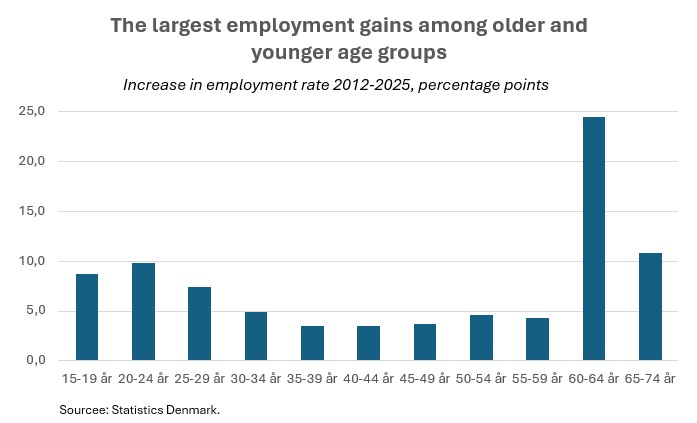
In 2012, 42 percent of 60–64‑year‑olds were employed. By 2025, that figure had risen to 67 percent. The increase of 25 percentage points corresponds to nearly 112,000 more 60–64‑year‑olds in employment compared to 2012.
Employment has also risen significantly among the youngest workers. Here, the employment rate has increased by 7–10 percentage points. Today, 71 percent of all 20–24‑year‑olds have a job.
The relatively largest increase in employment has occurred within the energy supply sector, but because this industry is relatively small, the growth of 7,200 employees represents only a small share of the total increase. Other industries with substantial growth include hotels and restaurants, knowledge services, and construction. Each of these sectors has seen around 50,000 additional employees over the past 13 years.
Foreign workers play a key role
In 2012, there were 192,000 employees in Denmark whose country of origin was non‑Danish. Thirteen years later, that number had risen to 430,000. Employees from other countries play a crucial role for Danish businesses. Without the many people who get up every morning and go to work, Denmark would be a poorer country, and many companies would not be able to grow in Denmark.
The largest increase in employment since 2012 has been among Ukrainians. Employment among Ukrainians has risen by 21,700 people. Other countries with large increases include Romania, Syria, and Poland, as shown in figure 2.
Figure 2
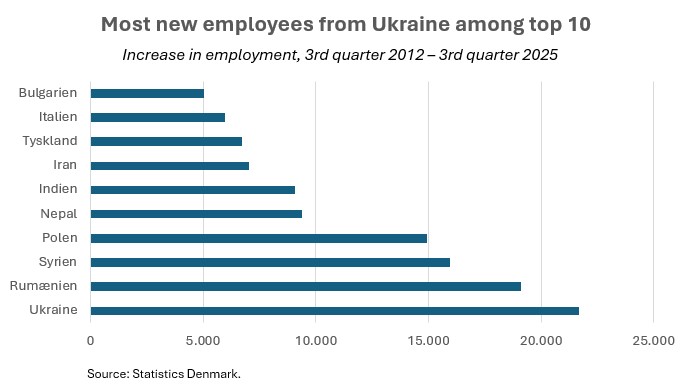
The reasons behind these increases vary. The wars in Ukraine and Syria have led to large groups of refugees, some of whom have subsequently entered the labor market.
The additional employees from the other countries in the top-10 have come to Denmark to work – either through EU´s right to free movement or through Danish work‑related residence schemes. Everyone who holds a residence permit under these schemes are employed, as working is a requirement for staying in Denmark.
Businesses expect growth – but they are uncertain
Construction companies and private service companies expect rising employment over the next three months. In contrast, the manufacturing sector expects declining employment. The expectation of rising employment in construction is likely also linked to the cold winter, which has limited building activity.
Most companies expect unchanged employment. Eighteen percent of construction companies expect rising employment, while 8 percent expect a decline. This results in a net balance of plus 10, as shown in figure 3.
Figure 3
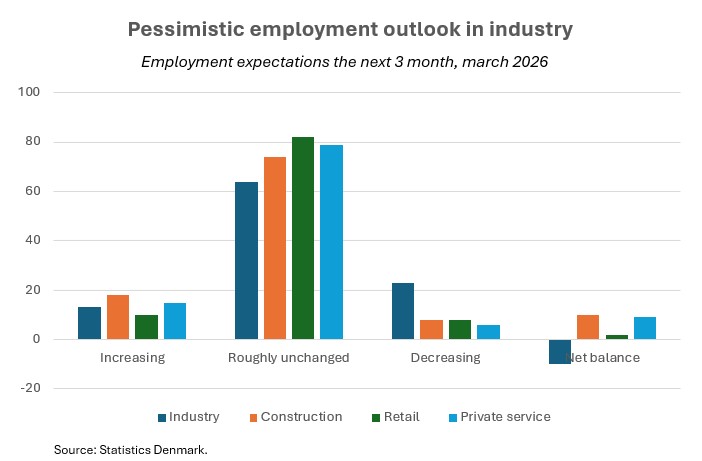
Manufacturing companies have a net balance of minus 10. There are 10 percentage points more manufacturing companies expecting declining employment than those expecting an increase in the coming three months. The February figure for manufacturing was plus 2, indicating that the conflict in Iran has negatively affected the sector’s employment outlook.
Large differences in how predictable companies find the business environment
Companies also confirm the high level of uncertainty when asked about the predictability of their business situation. For example, 91 percent of pharmaceutical companies consider the business environment difficult to predict.
Companies in construction find the business environment significantly more predictable.
Among service companies, travel agencies and airlines consider the outlook highly unpredictable, while telecommunications and insurance companies find conditions more predictable.
Littler comments
Employment has increased significantly over a very long period. Achieving even higher employment requires that companies have favourable conditions for hiring seniors and international employees. It also requires that companies work consistently and strategically to improve access to labour, particularly in these two areas.
There is considerable uncertainty about the future for many companies. The war in Iran and unstable market conditions in the United States are major challenges for many businesses. Companies’ ability to adapt will continue to be crucial.
If you need advice on:
- recruiting international employees
- including senior workers
- increasing or reducing your workforce
You can contact us here.
Erik Simonsen
Senior Director
+45 44 14 30 96